


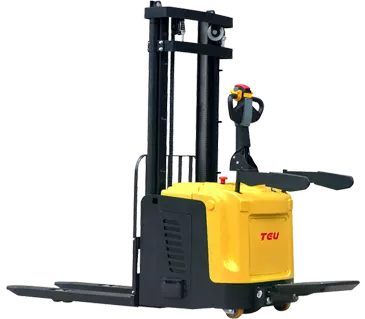
In the demanding world of heavy-duty material handling, the 5-ton (5t) electric forklift represents a critical balance between raw power and operational agility. However, the hardware is only as capable as the energy stored within it. As logistics hubs and manufacturing plants migrate toward sustainable energy, the debate between forklift battery technology options—specifically Lithium-ion (Li-ion) and Lead-Acid—has intensified.
When evaluating which power source drives your 5t forklift further, the answer isn’t just about distance; it’s about duty cycles, energy density, and the 5 ton electric forklift specs that determine long-term ROI. In this comprehensive guide, we dissect the nuances of the 5t lithium forklift battery versus traditional lead-acid solutions to help you make an informed fleet decision.
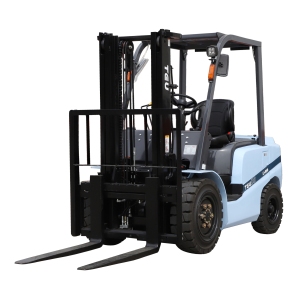
1. The Engineering Evolution: Forklift Battery Technology
For decades, lead-acid batteries were the undisputed champions of the warehouse. They provided the heavy counterweight necessary for lifting and a relatively low entry price. However, as global supply chains demand 24/7 uptime, the limitations of lead-acid—long charging times, high maintenance, and rapid voltage drops—have become bottlenecks.
Enter Lithium-ion technology. Modern 5t lithium forklift batteries utilize Lithium Iron Phosphate (LiFePO4) chemistry, which is renowned for its thermal stability and high energy density. Unlike lead-acid, which relies on a chemical reaction involving lead plates and sulfuric acid, Li-ion batteries move lithium ions between electrodes. This fundamental difference in forklift battery technology translates into higher efficiency and a significantly longer lifespan.
2. Power Consistency and Runtime: Driving “Further”
When we talk about driving “further,” we refer to the “effective runtime” per shift. A 5t forklift carrying heavy machinery or dense materials requires high current draws.
The Lead-Acid Power Fade
Lead-acid batteries suffer from a “voltage sag” as they discharge. As the battery reaches 50% capacity, the power delivery to the motors decreases, leading to sluggish performance and slower lift speeds. To protect the battery from permanent damage, it shouldn’t be discharged below 20%. This effectively gives you only 60-70% of the rated capacity to work with.
The Lithium-Ion Advantage
A 5t lithium forklift battery maintains constant voltage throughout the entire discharge cycle. Whether the battery is at 90% or 10%, the operator experiences the same level of torque and hydraulic speed. For a high-capacity machine like the TEU FLB5 series, this means consistent productivity from the start of the shift to the very end.
Furthermore, Lithium batteries support a 90-95% Depth of Discharge (DoD), meaning you can actually use almost all the energy you paid for without harming the cells.
3. Comparing 5 Ton Electric Forklift Specs: A Technical Breakdown
To understand the impact on a 5t machine, let’s look at the typical 5 ton electric forklift specs when equipped with different power sources.
|
Feature |
5t Lead-Acid Battery |
5t Lithium-Ion Battery (e.g., TEU FLB5) |
|
Nominal Voltage |
80V |
80V (High Stability) |
|
Charge Time |
8–12 Hours |
1–2 Hours |
|
Opportunity Charging |
Not Recommended (Damages Cells) |
Highly Encouraged (Boosts Uptime) |
|
Cycle Life |
1,500 Cycles |
3,000 – 5,000+ Cycles |
|
Maintenance |
Weekly Watering & Equalizing |
Zero Maintenance |
|
Energy Efficiency |
~75% |
>95% |
The TEU FLB5 5.5t Lithium-ion Forklift exemplifies these specs. By integrating high-voltage lithium systems, it eliminates the need for battery rooms and spare battery swapping, which are mandatory for 5-ton lead-acid fleets working multi-shift operations.
4. Operational Efficiency: The “Opportunity Charging” Revolution
In a traditional 5t lead-acid setup, the “8-8-8 rule” usually applies: 8 hours of use, 8 hours of charging, and 8 hours of cooling. This necessitates multiple batteries per truck for multi-shift operations, as well as expensive charging stations and ventilation systems to manage toxic fumes.
5t lithium forklift batteries thrive on “opportunity charging.” Operators can plug the forklift in during a 15-minute coffee break or a 30-minute lunch. This “fast-charge” capability adds significant capacity back into the battery, allowing a single lithium-powered 5-ton forklift to run through three consecutive shifts without ever swapping the battery. This is a game-changer for high-throughput environments like ports or heavy manufacturing.
5. Total Cost of Ownership (TCO): The Real Bottom Line
While the initial purchase price of a 5t lithium forklift battery is higher than lead-acid, the Total Cost of Ownership (TCO) tells a different story over a 5-year period.
- Electricity Savings: Li-ion is roughly 30% more energy-efficient. Less energy is lost as heat during charging and discharging, directly reducing your utility bill.
- Labor Costs: Lead-acid batteries require weekly “watering” (adding distilled water) and cleaning to prevent acid corrosion. Lithium is maintenance-free, saving hundreds of labor hours per year.
- Longevity: You will likely replace a lead-acid battery 2 to 3 times during the lifespan of a single lithium battery.
- Space Optimization: Eliminating the “battery room” allows facilities to reclaim valuable square footage for storage or production.
6. Safety and Environmental Sustainability
Modern ESG (Environmental, Social, and Governance) goals are pushing companies toward cleaner forklift battery technology.
- Zero Emissions: Lithium batteries do not “off-gas” during charging, making them safer for indoor use and food-grade environments.
- Reduced Risk: No handling of sulfuric acid means no risk of chemical burns or spills.
- BMS Protection: A high-quality 5t lithium forklift battery comes equipped with a sophisticated Battery Management System (BMS) that monitors cell temperature, voltage, and health in real-time, preventing overheating or short circuits.
7. Spotlight: The TEU FLB5 Series – The Peak of 5t Lithium Performance
When looking at the 5 ton electric forklift specs of the market leaders, the TEU FLB5 Series stands out. It isn’t just a forklift with a battery swapped in; it is an engineered ecosystem designed to maximize the benefits of lithium technology.
With its ergonomic design and high-capacity lithium core, the FLB5 handles the rigors of 5-ton lifting with the quiet efficiency of a smaller electric unit but the power of an internal combustion (IC) engine. It represents the transition from “buying a battery” to “investing in an energy solution.”
Conclusion
If your operation involves light usage and a single shift, lead-acid may still offer a lower entry cost. However, for any business focused on maximizing the potential of their 5 ton electric forklift, lithium-ion is the clear winner.
The 5t lithium forklift battery drives your business further by offering more “uptime,” higher energy efficiency, and a significantly lower TCO. By embracing advanced forklift battery technology, you aren’t just moving pallets; you are future-proofing your entire logistics infrastructure.
FAQ
Q1: Can I retro-fit my old 5-ton lead-acid forklift with a 5t lithium forklift battery? Yes, many manufacturers offer “drop-in” lithium replacements. However, to get the full benefit of 5 ton electric forklift specs—such as integrated software communication and optimized weight distribution—it is often more cost-effective to invest in a purpose-built lithium model like the TEU FLB5.
Q2: How does cold weather affect 5t lithium forklift battery performance? Lithium batteries can lose efficiency in extreme cold. However, high-end forklift battery technology now includes internal heaters that keep the cells at optimal operating temperatures, ensuring that 5t forklifts perform reliably even in cold storage environments.
Q3: Is a 5-ton electric forklift powerful enough to replace a 5-ton diesel forklift? Absolutely. With current 5t lithium forklift battery tech, electric forklifts now match or exceed the torque and acceleration of diesel counterparts. They provide a cleaner, quieter, and more cost-efficient alternative without sacrificing the lifting capacity required for 5-ton loads.